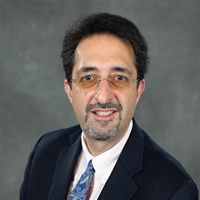
Reza Habib
Dr. Reza Habib received his Ph.D. in Psychology from the University of Toronto in 2000 working with Dr. Endel Tulving. He was a postdoctoral fellow at the Rotman Research Institute in Toronto. He joined SIU as an assistant professor in the Fall of 2003. Dr. Habib 's research interests include brain imaging (fMRI) and statistical methodology, and long-term learning and memory.
Educational History
Ph.D., University of Toronto
Interests
Brain imaging; long-term learning and memory; pathological gambling
Courses
- PSYC 310: Cognitive Psychology
- PSYC 489: Seminar – Selected Topics (Cog Neuro)
- PSYC 515: Theory & Research in Cognitive Psychology
- PSYC 522: Experimental Design and Analysis
- PSYC 524: Multivariate Methods of Psychology
Representative Publications:
Bergdahl, M., Habib, R., Bergdahl, J., Nyberg, L., & Nilsson, L.-G. (In Press). Natural teeth and preserved cognitive function in humans. Scandinavian Journal of Psychology.
Herlitz, A., Thilers, P.P., & Habib, R. (In Press). Endogenous estrogen is not associated with cognitive performance before, during, and following menopause. Menopause.
Habib, R., Nyberg, L., & Nilsson, L-.G. (In Press). Cognitive and non-cognitive factors contributing to the longitudinal identification of successful older adults in the Betula study. Aging, Neuropsychology, and Cognition.
Schott, B. H., Sellner, D. B., Lauer, C.-J., Habib, R., Frey, J. U., Guderian, S., Heinze, H.-J., & Düzel, E. (2004). Activation of midbrain structures by associative novelty and the formation of explicit memory in humans. Learning and Memory, 11(4), 383-387.
Düzel, E., Habib, R., Guderian, S., & Heinze, H.-J. (2004). Four types of novelty-familiarity responses in associative recognition memory of humans. European Journal of Neuroscience, 19(5), 1408-1416.
Chau, W., Habib, R., & McIntosh, A. R. (2004). Multi-modal imaging data analysis with partial least squares. Brain and Cognition, 54(2), 140-142.